

High commissions don’t make affiliate marketing effortless. The Millionaire Partner System is an affiliate marketing program with training and tools to track clicks, conversions, sales, and commissions. A useful Millionaire Partner System review looks beyond the commission pitch to what the program includes and the work involved in using it.
It’s reasonable to want clear answers before investing time or money in an online business program. This review explains what the system offers, how its affiliate tracking works, what to consider about the cost, and its main advantages and drawbacks. Use it to judge whether the training and workflow fit your goals, audience, and willingness to generate traffic.
Key Takeaways
- Understand how affiliate links connect clicks to conversions, sales, and commission records, and why traffic quality matters to the process.
- See what the program’s training and pre-built funnels are designed to support before deciding whether they fit your working style.
- Compare the one-time payment with the installment option to understand how payment structure affects the total cost.
- Weigh the convenience of high-ticket affiliate marketing against the time, traffic-building effort, and uncertainty involved in earning commissions.
- Explore the member area, video courses, or free web class as learning options aligned with your next step.
Affiliate click, conversion, sales, and commission tracking
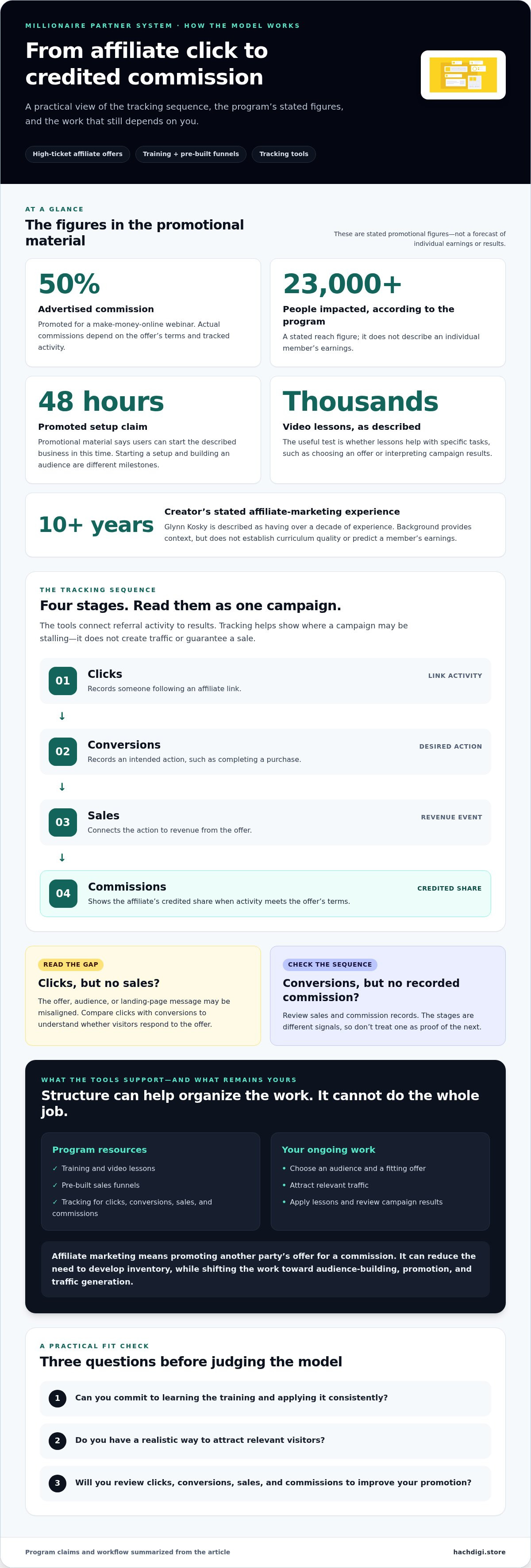
Compared with programs focused on low-priced products, the Millionaire Partner System emphasizes high-ticket affiliate offers and built-in tracking. Its advertising promotes a 50% commission on a make-money-online webinar, while the tracking tools cover clicks, conversions, sales, and commissions.
These stages show how a referral moves through an affiliate campaign. A click records someone following an affiliate link; a conversion records a desired action, such as completing a purchase. A sale connects that action to revenue, while commission tracking shows the affiliate’s credited share. For example, clicks without conversions point to a different problem than conversions without recorded commissions.
Read the figures as a sequence, not as separate signs of success. First, compare clicks with conversions to see whether visitors respond to the offer. Then check recorded sales and commissions to learn whether those actions produce credited earnings. If a campaign gets clicks but no sales, the offer, audience, or landing-page message may be misaligned. Tracking can help identify the gap, but it doesn’t create traffic or guarantee a sale.
The program also combines affiliate marketing training with pre-built sales funnels. These resources provide a promotional structure, so users don’t have to build every page from scratch. A funnel can guide visitors from an initial message toward an affiliate offer. You still need to choose an audience, attract relevant traffic, and explain why the offer fits.
The program’s promotional material describes thousands of video lessons. That breadth may offer instruction on many topics, but the useful measure is whether lessons help with specific tasks, such as selecting an offer or interpreting campaign results. Follow a focused learning path: understand the model, apply a lesson, then review the clicks and conversions before changing several campaign elements.
Affiliate marketing differs from selling a product you create. An affiliate promotes another party’s offer and earns a commission when tracked activity meets the offer’s terms. This can reduce the need to develop inventory, but shifts the work toward building an audience, promoting offers, and generating traffic. The program’s tracking tools help connect those activities to results.
To decide whether the platform suits your approach, consider three practical questions:
- Can you commit to learning the training and applying it consistently?
- Do you have a realistic way to attract relevant visitors?
- Will you review clicks, conversions, sales, and commissions to improve your promotion?
The Free Affiliate Marketing Web Class 2026 offers an introductory learning option for people comparing affiliate models. Use the ideas to distinguish training from execution: lessons and funnels can organize the work, while traffic and audience fit influence whether referrals progress. That distinction is central to evaluating any affiliate program, including one built around high-ticket offers.
Compared with programs centered on lower-priced products, it focuses on higher-ticket offers and combines tracking tools with training and pre-built sales funnels. Its promotional materials advertise a 50% commission on a make-money-online webinar, while actual results still depend on attracting relevant traffic and converting it.
Program overview and creator background
The Millionaire Partner System is an affiliate marketing training program created by Glynn Kosky. The creator, training materials, and promotional claims provide useful context for understanding what members are being asked to learn.
Program Overview
The Millionaire Partner System packages online training and affiliate resources around promoting offers for commissions. Its promotional material says the program has impacted over 23,000 people. That figure describes the program’s stated reach, not an individual member’s earnings. For readers, the distinction helps separate the size of a program from evidence about personal results.
The offer combines video lessons with pre-built sales funnels, giving members instruction and promotional structures. Its promotional material describes thousands of video lessons and says users can start the described business in 48 hours. Those claims suggest a ready-made framework, but starting a setup and building a functioning audience are different milestones.
In practice, the model centers on learning how affiliate offers work and applying that knowledge to promotion. Consider whether online training, funnel resources, and an affiliate-based business model match your preferred way of working. The official program presentation also promotes high-ticket offers, so understand the offer type before joining.
Creator Background
Glynn Kosky is described as having over a decade of experience in affiliate marketing. That background helps explain the program’s focus on promotion and commission-based sales. It provides context about the creator’s stated experience, but a separate question remains: do the lessons suit your starting point and learning needs?
Experience alone doesn’t establish the curriculum’s quality or predict a member’s earnings. To assess the creator’s role, consider the stated background alongside the program’s structure: video-based online training, affiliate offers, and promotional resources. Someone new to affiliate marketing may value foundational lessons, while an experienced marketer may focus on the specific workflow.
The program’s scale and creator background provide context, not a shortcut to deciding whether it fits. Distinguish the system’s stated reach from your own objectives, such as learning affiliate promotion, building an online business, or using the provided resources. Those goals call for different expectations. A figure about reach can describe the program, but it can’t tell you how much time you’ll spend applying the training or what you may earn.
Program pricing and installment options
Payment structure affects cash flow, while the total cost affects whether you decide to join. The available formats include a one-time payment and an installment plan paid across three monthly payments. Look beyond the amount of each payment: consider the total commitment, your budget, and whether you can fund the work involved in generating traffic.
An installment plan spreads payments over time, but a smaller payment doesn’t automatically make a program affordable. Compare each scheduled payment with your existing commitments before enrolling. Then decide whether paying once or in installments better protects your available cash. This is especially important before affiliate commissions begin, since future income isn’t money you can spend now.
Klarna financing may run for 6 to 36 months, depending on credit. That option changes the payment timeline, not the effort required to apply the training. Review the length of the financing alongside your other obligations. A longer repayment period can extend the commitment, so weigh convenience against how long you want payments to remain part of your budget.
Separate the program purchase from the business model’s promotional language. The materials describe a business that can start with no upfront investment, but that statement concerns the described business, not the cost of joining the training program. Affiliate marketing can require time and resources to attract traffic, and commissions are not automatic.
The refund policy offers another point to assess. The program has a 60-day refund policy, subject to conditions requiring the buyer to use the program. That means the refund window is tied to participation, not simply to waiting. Keep records of your use and follow the stated process within the applicable period. A refund policy can affect purchase risk, but it does not replace checking whether the payment structure fits your finances.
Consider possible upgrades separately from the initial enrollment. For each additional offer, identify what it adds, whether it suits your current learning stage, and whether the commitment fits your budget. Don’t assume an upgrade is necessary to use the core training. Ask whether it solves a specific obstacle in your affiliate workflow.
For a grounded decision, compare the options using these factors:
- Payment timing: choose between paying once and spreading payments across three months.
- Financing term: account for Klarna’s 6-to-36-month range and credit-based eligibility.
- Refund conditions: factor in the 60-day period and required program use.
- Expected effort: plan for traffic generation before relying on future commissions.
Pros and cons
The main trade-off is structured affiliate training versus the work required to apply it. Risks include spending time without making sales and relying on traffic you have to generate yourself.
Beginner Suitability
The program may suit beginners who want lessons and promotional resources in one place. Starting from scratch means learning both affiliate marketing concepts and how to apply them.
Training can organize that learning, but beginners still need to practice choosing an audience, presenting an offer, and reviewing results. For example, study a lesson, apply its advice to one campaign, then assess whether the message attracts relevant visitors. That cycle takes consistent effort, not just access to lessons.
Risks and Extra Expenses
The main risks are committing time and money before developing a reliable way to attract traffic. Useful skills include writing clear promotions, understanding an audience, and interpreting clicks and sales.
Paid traffic or optional business tools can add operating expenses, depending on your approach. Treat them as separate decisions rather than assuming every resource is included with the training. For instance, if you rely on paid promotion, account for that spending even if a campaign generates no commissions.
Promotional claims also deserve careful interpretation. These are marketing claims, not personal income forecasts. A realistic plan should focus on learning, traffic, and measurable sales activity.
One advantage is a defined affiliate model: training, funnels, and tracking tools can give users a framework for promoting offers. High-ticket commissions may also mean a successful sale carries more weight than a low-priced product sale. But that commission opportunity matters only when a relevant visitor acts and the sale is credited.
The drawback is the gap between a ready-made structure and a working business. Pre-built funnels can reduce setup work, but they don’t choose an audience or generate traffic on their own. Anyone expecting fully automated income may underestimate the effort required to test and adjust promotions.
Consider the fit through these practical trade-offs:
- Structured learning: useful if lessons help you act, not just watch.
- Funnel resources: helpful for setup, but traffic still needs a strategy.
- Commission potential: tied to successful referrals, not simply enrollment.
- Time and expenses: include promotion work and any optional tools you choose.
For beginners, the strongest reason to proceed is a willingness to learn and test consistently. If your plan depends on guaranteed income or effortless results, the system’s demands may not match your expectations.
What the Millionaire Partner System offers
The system combines affiliate training with promotional resources and bonuses. It is presented to an international audience, including U.S. customers. For U.S. participants, practical tax considerations include keeping organized records of commissions and business expenses for tax preparation under the rules that apply to their circumstances.
A key feature is the ready-made support for promoting affiliate offers. The program provides pre-built sales funnels, giving campaigns a landing structure without requiring every page to be created from scratch. A funnel organizes the path from an initial promotion to an offer. It doesn’t bring visitors by itself, so generating traffic remains a separate part of online marketing.
The offer also includes training described as thousands of video lessons. This breadth may help users explore different aspects of affiliate marketing, but its value comes from applying relevant lessons to real work. For example, study audience selection, use what you learn to shape a landing page, and review whether visitors respond.
Several bonuses are promoted alongside the core system. These describe bonus material, not a promise that participants will reproduce the campaigns or results.
Treat each claim as conditional: the stated earnings threshold and conditions matter, and the headline alone doesn’t explain eligibility.
In practical terms, the system offers a structured mix of instruction, funnels, and supplementary resources. That combination may reduce setup work, while core business tasks remain the participant’s responsibility. Choosing an audience, generating relevant traffic, and evaluating campaign performance still take effort. Results depend on connecting those activities to a suitable offer, not simply having access to materials.
Before joining, match each resource to a task you need to complete. A beginner may value guided lessons; someone with campaign experience may focus on the case study or scaling material. Keep separate records of commissions and expenses as your activity develops, then use them to understand the business side of your affiliate work.
Explore the Millionaire Partner System if its training and promotional resources fit the way you want to build an affiliate business.
Hachemi Benaissa digital product store: Millionaire Partner System
Hachemi Benaissa digital product store offers the Millionaire Partner System for readers ready to explore its affiliate marketing training. If you’re still comparing approaches, the Free Affiliate Marketing Web Class 2026 provides an introductory way to learn about affiliate marketing before choosing your next step.
If you want a more structured learning experience, the member area and video courses provide a place to follow the program material and build understanding over time. Choose the option that fits your current goal: learning the model or working through the system’s training and resources.
Visit hachdigi.store to explore the Millionaire Partner System and its learning options.
Turn Your Research Into a Clear Next Step
First decide what you want to learn about affiliate marketing. Set a practical goal, such as understanding the business model or becoming more confident with promotional resources. Then use this Millionaire Partner System review as a decision filter: does the program’s format fit the way you prefer to learn and work?
Hachemi Benaissa digital product store offers the Millionaire Partner System, a member area and video courses, and the Free Affiliate Marketing Web Class 2026. These options can support different starting points, from exploring affiliate marketing to working through structured learning materials. Focus on the format that aligns with your immediate learning goal, rather than trying to pursue every resource at once.
Make your next step deliberate: identify what you want to learn, choose a fitting option, and put that knowledge into practice. Visit hachdigi.store to explore the learning options and decide which one best fits your direction. A thoughtful start can turn research into steady progress.
Frequently Asked Questions
What Is the Millionaire Partner System?
The Millionaire Partner System is an affiliate marketing training program built around promoting offers and earning commissions from tracked sales. It combines lessons with promotional resources, helping participants learn the model and explore ways to market offers. Glynn Kosky created it. A review should distinguish the training structure from the work of applying it to an audience and an affiliate offer.
Commissions require successful referrals, and generating relevant traffic is part of the work. For a practical assessment, focus on what you can control: choosing an audience, matching an offer to its needs, and reviewing whether your promotions lead to sales.
Is it suitable for beginners?
It may suit beginners who are prepared to learn affiliate marketing and apply the lessons themselves. Training and pre-built resources offer a starting structure, but they don’t replace audience research or promotion. A new marketer might first learn how an offer works, then draft a simple promotion and assess the response. Fit depends on your willingness to practice, not just watch lessons.
How does the Millionaire Partner System work, step by step?
The basic process moves from learning the model to promoting an offer and reviewing tracked results. Use this sequence to understand the workflow:
- Study the training and choose an affiliate offer.
- Use promotional resources, such as a pre-built funnel, to present it.
- Attract relevant visitors through a traffic source.
- Review clicks, conversions, sales, and credited commissions.
Each stage informs the next campaign decision.
How much does the Millionaire Partner System cost, including upsells or recurring fees?
The program offers one-time and installment payment options, and the installment route carries a higher total commitment. Treat any optional offer presented during checkout as a separate purchase decision. For a realistic budget, compare the full payment obligation and review the purchase terms before proceeding. Also separate the program cost from any optional spending on promotion or business tools.
What products, training, and support are included?
The program’s materials include video lessons, pre-built sales funnels, and additional bonus resources. Promoted bonuses include a live campaign case study and high-ticket scaling strategies. The member area and video courses provide an educational format for working through the material. These are training and promotional resources, so plan to apply them yourself, for example by adapting a funnel to the offer and audience you choose.
What do independent customer reviews say about the Millionaire Partner System?
Feedback is mixed, so a Millionaire Partner System review should look for concrete details rather than rely on a single verdict. One review summary reports that 80% of reviews were negative and 20% positive. Individual accounts describe different experiences, including concerns about earnings expectations, workload, or refund handling. Look for what each reviewer purchased and did, rather than treating one account as a forecast of your results.
What are the refund policy and cancellation rules for the Millionaire Partner System?
The program offers a 60-day refund policy, subject to conditions that require the buyer to use the program. Keep your purchase details and records of program use together, and submit a refund request within the stated period if needed. Cancellation and refund are distinct actions, so read the purchase terms for the applicable cancellation process and any ongoing commitments before completing enrollment.